
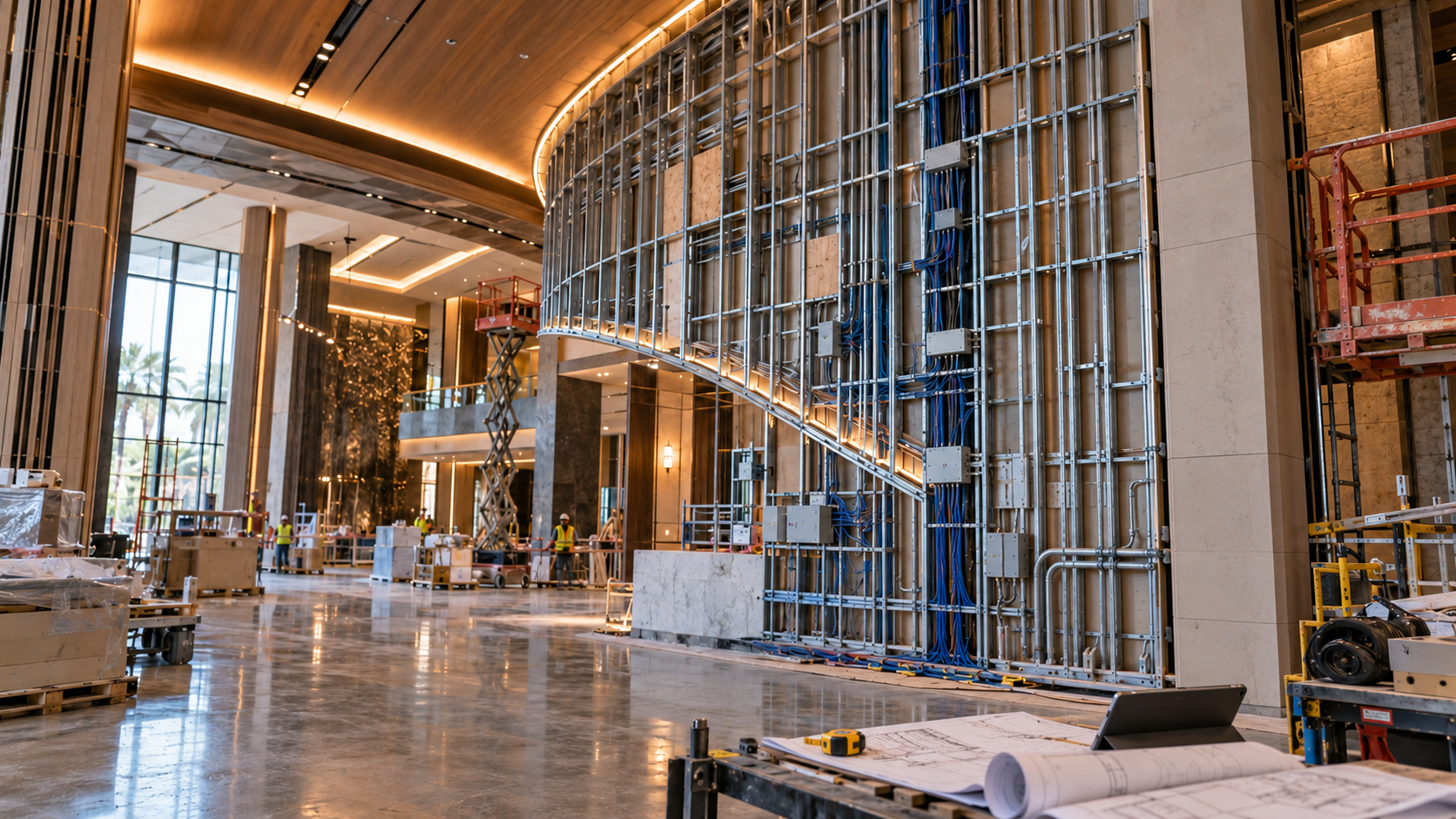
Hotel and casino AV planning, including LED displays, should begin during concept design or schematic design, before power, data, structure, cooling, ceiling coordination, and finish details are fixed. The display may be one of the last systems installed, but the decisions that determine whether it fits, performs, and can be maintained are made much earlier.
That distinction matters in hotels, integrated resorts, and casinos because technology touches almost every guest-facing environment. A lobby feature wall, sportsbook display, ballroom system, gaming-floor signage network, nightclub, restaurant, and exterior media facade may all share infrastructure, control, content, and support requirements. If each space is treated as an isolated equipment purchase, the property inherits unnecessary complexity. If the systems are planned together, the technology can support the architecture and daily operation without announcing all the work behind it.
The best starting point is before design development
The most useful answer is not a fixed number of months before opening. It is a point in the design process.
Bring the AV and LED team into the project while the architect and engineering consultants can still act on the information. At this stage, the team can confirm what the technology must accomplish, where it belongs, what infrastructure it requires, and how it will be operated. The project still has room to adjust wall depth, structure, conduit routes, equipment rooms, access panels, HVAC, finishes, and sightlines without treating every change as a retrofit.
The AVIXA Audiovisual Best Practices guide describes AV as a process that runs from planning and design through installation and performance verification. That sequence reflects a basic construction reality: the quality of the finished system depends on decisions made before the equipment reaches the site.
ExtraPRO's technology design-build process follows the same principle. Creative design, engineering, documentation, procurement, integration, commissioning, and client readiness are coordinated as one scope instead of being handed from one party to the next.
What should be decided at each project stage
| Project stage | LED and AV decisions that belong here | Cost of waiting |
|---|---|---|
| Concept design | Audience, use cases, locations, scale, creative intent, preliminary budget, operator needs | The project may reserve the wrong space or budget for the experience it wants |
| Schematic design | Display geometry, sightlines, service strategy, structural concept, equipment locations, content approach | Architecture and system requirements begin to conflict |
| Design development | Power, data, heat loads, conduit, mounting, rack elevations, control, acoustics, lighting coordination | Changes become RFIs, redesign, or added construction scope |
| Construction documents | Final specifications, details, responsibility matrix, acceptance criteria, schedules | Missing requirements appear as exclusions or assumptions in bids |
| Procurement and fabrication | Approved products, submittals, samples, lead times, mockups, factory testing | Substitutions and schedule pressure reduce review time |
| Construction and commissioning | Installation sequencing, calibration, testing, training, documentation, content loading | Defects are found close to opening, when recovery options are limited |
The table is not a rigid procurement model. A renovation, tenant improvement, or phased resort expansion may enter the process later. The point is to make the decisions while the people responsible for the surrounding work can still coordinate them.
The screen is only one part of the decision
A large LED wall is visually dominant, so discussions often begin with dimensions, pixel pitch, and brightness. Those are important, but they do not define the full system.
The project team also needs answers to questions that live outside the display specification:
- What supports the display weight, and where does that load transfer?
- Can technicians reach power supplies, receiving cards, and modules after the finishes are complete?
- Where will processors, media players, network switches, and control equipment live?
- What are the maximum and expected electrical loads?
- How will heat leave the display cavity and equipment room?
- Which system owns scheduling, source selection, emergency messaging, and user permissions?
- Who creates, approves, updates, and archives the content?
- What must be proven during commissioning before the system is accepted?
Those questions involve architecture, structural engineering, electrical engineering, mechanical design, IT, operations, marketing, security, and the general contractor. Waiting until procurement to answer them forces the AV team to work around decisions that were made without the system in mind.
Early planning protects the architecture
Good technology coordination is often invisible in the finished space. The display aligns with the architecture. Access panels land where they can be used. Speakers, cameras, sensors, and lighting do not compete for the same ceiling locations. Equipment rooms have the correct power and cooling. Cable routes are serviceable. Control interfaces match the way the venue operates.
Late coordination produces the opposite. A wall must become deeper to create service access. A structural member crosses a cabinet seam. A rack is moved into a room that cannot reject its heat. Conduit arrives on the wrong side of the display. A feature ceiling is opened after completion because a pathway was omitted. These are construction problems, not product problems, and a premium display cannot solve them.
For a custom installation, the display geometry should be developed with the architecture rather than fitted into whatever space remains. ExtraPRO's custom LED work begins with viewing distance, content, service access, operating conditions, and the surrounding materials. That approach is especially important for curved, transparent, corner, suspended, and unusually shaped displays.
Operations should have a seat at the design table
Hotels and casinos do not operate like showrooms. Content changes. Events arrive with different sources. Promotions need approval. Gaming, security, marketing, entertainment, food and beverage, and IT teams may share the same network or displays. Systems run long hours, and a service interruption can affect guests, revenue, or brand presentation.
The operator can answer questions that drawings cannot:
- How often will content change?
- Does the property need local control, remote publishing, or both?
- Which spaces must continue operating if the network connection fails?
- Who may override scheduled content?
- How quickly must a failed component be restored?
- What training and documentation will the on-site team actually use?
These answers influence the media-player architecture, network security, redundancy, spare-parts plan, service agreement, and user interface. They should be part of design, not a training conversation held days before opening.
Content planning belongs in the same conversation
A display can be technically correct and still underperform because the content was treated as an afterthought. The physical canvas determines aspect ratio, pixel map, viewing angle, motion scale, brightness behavior, and safe composition areas. A curved wall, transparent surface, narrow ribbon, or corner display cannot be approached like a standard television.
Early content planning helps the creative team establish what the canvas is for. Ambient art, promotional media, wayfinding, live video, data, sponsorship, and show content place different demands on the system. Once the intent is clear, the project can select the right resolution, processor, playback platform, storage, bandwidth, and control workflow.
ExtraPRO's content and experience design team develops creative and technical requirements together, from storyboards and pixel maps through playback and on-site calibration. This prevents the common situation in which expensive hardware opens with resized landscape videos that were never designed for the space.
A practical early planning checklist
Before design development is complete, the project should have a documented answer for each item below.
Experience and audience
- The purpose of each display and system
- Closest, typical, and farthest viewing positions
- Primary content types and operating hours
- Required guest, employee, event, or revenue outcomes
Architecture and engineering
- Display dimensions, geometry, depth, weight, and mounting concept
- Front-service or rear-service access
- Preliminary power, heat, data, and rack requirements
- Conduit, pathway, penetration, and grounding strategy
- Ambient light, acoustics, and finish coordination
Operations and content
- Content owners, approvers, and update frequency
- Local, cloud, or hybrid publishing method
- Source switching and control requirements
- Monitoring, redundancy, spare parts, and support expectations
- Training, handover documents, and acceptance tests
If several of these items remain unknown, the project is not ready for a final equipment quote. It may be ready for a budget, basis of design, or concept package, but those numbers should be labeled accordingly.
What if the project has already started construction
Late is not the same as impossible. The team should quickly document the conditions that are already fixed and identify where flexibility remains.
Start with a coordinated site survey and current drawing review. Confirm dimensions, structure, available power, pathways, rack space, network readiness, HVAC conditions, access, and construction sequencing. Then issue a short decision log that separates three things:
- Requirements that can still be met as designed
- Requirements that need an architectural or engineering change
- Requirements that must be reduced, relocated, or deferred
This gives the owner a factual basis for deciding where to spend contingency. It is better than carrying an idealized design into construction and discovering the conflicts during installation.
The decision to make now
If a hotel, resort, or casino project expects technology to shape the guest experience, AV planning belongs in the design conversation before the construction documents are finished. Start with the audience and operation, then coordinate the physical system around them.
The immediate next step is not necessarily selecting a display model. It is establishing a coordinated basis of design that the architect, engineers, operator, creative team, and contractor can use. That document turns an ambition into requirements that can be drawn, priced, built, tested, and supported.
For the procurement stage, see our guide to writing an LED display RFP that produces comparable bids.
Discuss your project with ExtraPRO if you need to align LED, AV, content, and infrastructure before the design is locked.
Frequently asked questions
How early should AV consultants join a hotel project
They should join during concept or schematic design, while locations, infrastructure, wall depth, equipment rooms, and budgets can still change without major rework.
Can LED be designed after the architect finishes the space
It can, but the result may require compromises in size, service access, structure, cooling, or finish integration. Custom and architecturally integrated displays benefit most from early coordination.
What information is needed for an early LED budget
At minimum, define the approximate dimensions, indoor or outdoor environment, viewing distance, content type, mounting condition, operating hours, service access, and desired level of integration. The budget should state which items are included and which remain allowances.
Who should participate in early AV planning
The owner, architect, AV designer or integrator, electrical and mechanical engineers, structural engineer, IT, operations, marketing or content owner, and general contractor should participate at the stages relevant to their scope.
Is design-build appropriate for a resort technology project
It can be a strong fit when the owner wants one accountable team to carry creative intent, engineering, procurement, integration, commissioning, and support. The contract and responsibility matrix should still define deliverables and acceptance criteria clearly.