
Indoor vs. Outdoor LED Display Specs: The Complete Specifier’s Guide
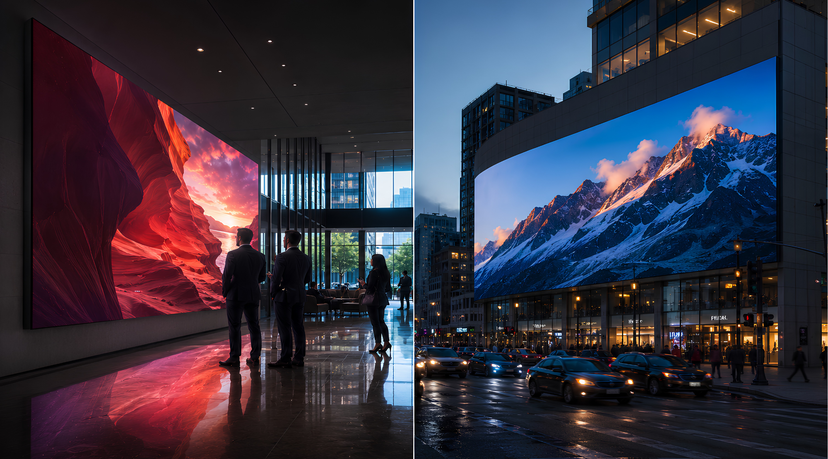
Indoor and outdoor LED displays serve different purposes and are not interchangeable.
Brightness, pixel pitch, weather protection, cabinet construction, thermal management, structural support, and service access must match the conditions where the display will operate. Otherwise, you may end up paying for performance capabilities the project does not need or select a display that cannot perform reliably.
This guide by Trust Fall Technology Group explains how indoor and outdoor LED display requirements differ and what specifiers should consider and verify before selecting a system.
Why Indoor and Outdoor LED Displays Require Different Specs
Indoor and outdoor LED displays require distinct technical specifications that align with their intended operating conditions.
Brightness, pixel pitch, ingress protection, cabinet construction, service access, mounting, and electrical planning must all match the installation environment. Failure to do so can result in washed-out content, early component failure, voided warranties, and unnecessary project costs.
Indoor displays are designed for controlled environments, while outdoor displays must withstand direct sunlight, rain, dust, wind, and temperature fluctuations. For example, an indoor-rated display installed outdoors may fail due to sunlight, moisture, and temperature fluctuations. An outdoor display placed indoors will add unnecessary costs for brightness and environmental sealing not needed in a controlled environment.
Covered and semi-outdoor spaces, such as stadium concourses, open-air retail areas, and covered plazas, require careful evaluation because they do not fit neatly into either category. These applications should be assessed individually based on actual light levels, weather exposure, temperature, and protection needs rather than automatically being classified as indoor or outdoor.
At a Glance: Indoor vs. Outdoor LED Display Specification Guidelines
The table below provides a general comparison of the specifications most likely to differ between indoor and outdoor LED display applications, with each covered in more detail below.
| Category | Indoor LED Displays | Outdoor LED Displays |
|---|---|---|
| Brightness | 600–1,500 nits (typical) | 5,000–10,000 nits (typical) |
| Pixel Pitch | Depends on viewing distance | Depends on viewing distance |
| IP Rating | Typically IP20–IP40 (not sealed) | Typically IP65 or higher; IP66 for more exposed or washdown environments |
| Operating Temperature | 0°C to 40°C (32°F to 104°F) | -20°C to 60°C (-4°F to 140°F) |
| Cabinet Design | Lightweight, aesthetic-focused, low-profile | Sealed, weather-resistant, corrosion-rated, heavier |
| Structural Needs | Wall backing, flatness, access, alignment | Wind load analysis, engineered mounting, seismic review |
| Service Access | Front-service for flush installs | Front or rear, depending on structure |
| Best-Fit Uses | Lobbies, boardrooms, retail, hospitality | Facades, stadiums, exterior signage, DOOH |
Key Differences Between Indoor and Outdoor LED Displays
Several technical specifications explain why an indoor LED display spec sheet should never match an outdoor LED display spec sheet. Requirements vary by brightness, pixel pitch, environmental protection ratings, cabinet construction, thermal management, service access, and necessary structural and electrical planning.
If any of these specifications do not align with the installation environment, the entire project team may encounter significant issues later in the process.
Brightness: How Many Nits Does an LED Display Need?
LED display brightness is measured in nits (candelas per square meter). The exact requirement depends almost entirely on ambient light conditions.
- Indoor displays typically run 600–1,500 nits in controlled lighting environments.
- Semi-outdoor and covered spaces, such as concourses, atria, and covered plazas, typically require 1,500–3,000 nits.
- Outdoor displays typically run 5,000–10,000 nits to remain legible in direct sunlight.
These differences explain why brightness must be matched to the installation environment. For example, a display that looks clear in a lobby may appear washed out on a facade at noon, while a facade-grade display used indoors at full brightness can create glare and eye fatigue.
Brightness requirements can also change as ambient light shifts throughout the day. Direct sun, shade, glazing, and nighttime operation all impact output needs. For this reason, automatic brightness control (ABC) is important, especially for outdoor installations and for displays behind glass, as it dynamically adjusts brightness in response to changing conditions.
In high-ambient-light environments such as the Las Vegas Strip, effective thermal management is also critical because excess heat can cause a display to automatically reduce its brightness.
Pixel Pitch and Viewing Distance: Getting Resolution Right Without Overspending
Pixel pitch is the distance in millimeters between adjacent pixel centers. It determines how close a viewer can stand to the display before the image resolves into individual dots.
The appropriate pixel pitch depends on both viewing distance and content type. Choosing a finer pitch than the space requires adds high cost with no perceptible benefit to the viewer.
General guidance for common indoor and outdoor applications:
- Indoor fine pitch (P1.2–P2.5): Interior applications with close viewing distances of 2–5 meters, such as boardrooms, lobbies, and high-end retail.
- Standard indoor (P2.5–P4): Larger indoor spaces with viewing distances of 5–10 meters.
- Outdoor (P4–P10): Exterior installations with viewing distances of 10 meters or more.
- Large-format outdoor (P10–P16+): Billboards, stadium exteriors, and highway DOOH with viewing distances of 30 meters or more.
Content type also influences pixel pitch requirements. Text, data, and other detailed content typically require a finer pitch than large-format motion content. To learn more about pixel calculation methodology, read “Pixel Pitch Explained: Choosing the Right LED Display for Your Install.”
Ingress Protection: How to Choose the Right IP Rating for an LED Display
An Ingress Protection (IP) rating measures how well an electrical enclosure seals against solid particles, such as dust, and liquids, such as water. IP ratings follow IEC 60529, a standard developed by the International Electrotechnical Commission.
Each rating contains two digits:
- The first number indicates protection against solid particles and is ranked on a scale from 0–6.
- The second digit shows the level of water protection and is measured on a scale from 0–9.
The appropriate IP rating depends on the installation environment (indoor vs. outdoor) and the screen’s physical accessibility (high-traffic vs. restricted areas).
Outdoor LED screens need a higher IP rating to withstand weather and airborne debris. Standard indoor LED screens in climate-controlled spaces, such as boardrooms, typically hold an IP20 or IP30 rating if out of public reach.
If in a high-traffic area, a protective technology that yields higher physical and environmental resistance, such as GOB (Glue-on-Board) or COB (Chip-on-Board), is recommended. A higher IP rating (generally IP65) is also necessary if the indoor display is exposed to severe moisture or washdowns.
What IP rating do outdoor LED displays need?
Outdoor LED displays should carry at least an IP65 rating to ensure they are dust-tight and resistant to low-pressure water jets from any direction. More exposed or washdown environments should specify IP66, which is dust-tight and resistant to powerful water jets. Covered outdoor spaces need careful evaluation because partial shelter does not eliminate exposure to humidity, windblown rain, or condensation.
It is important to note that the rating on the LED module does not automatically apply to the entire installed system. Never accept an “outdoor-rated” claim without verifying the display’s IP rating and which components that rating applies to. Always confirm that the rating applies to the front panel, rear panel, complete cabinet, power supply enclosure, control electronics, or another component.
What is the difference between a NEMA Rating and an IP rating?
NEMA ratings and IP ratings overlap and are frequently cross-referenced, but they are not the same or directly interchangeable. The main differences are who defines them and what they cover.
An IP rating, defined by the International Electrotechnical Commission (IEC), measures protection against solid particles and water ingress. A NEMA rating, defined under ANSI/NEMA 250 by the National Electrical Manufacturers Association, covers similar factors and additional conditions such as corrosion, oil, and icing.
LED video walls are typically sold and categorized by global IP ratings, while NEMA ratings are more common in North American electrical documentation.
Physical Design: Cabinet Construction, Thermal Management, and Service Access
An LED display’s physical construction, including cabinet design, cooling requirements, and service access, affects installation, maintenance, and long-term performance as much as any image specification. Each must be planned for the installation environment and the space’s physical requirements.
Cabinet Construction
Outdoor LED cabinets must be sealed, built to shed water, and rated to resist corrosion. Indoor LED cabinets prioritize a lower profile, lighter weight, and cleaner integration, all of which affect wall depth and mounting decisions. These differences also affect the display’s overall weight, structural support requirements, installation depth, and integration into the surrounding architecture.
Thermal Management
Thermal management plays a major role in long-term LED display performance and is often where longevity is won or lost.
Indoor displays typically operate in climate-controlled spaces, while outdoor displays must handle direct sun, higher ambient temperatures, and wider temperature swings.
Elevated operating temperatures can shorten the life of power supplies and degrade brightness consistency over time. Outdoor displays exposed to direct sun and ambient temperatures above 35°C (95°F) may require active cooling, ventilation design, or both.
Service Access
Service access determines how technicians reach internal components for maintenance and repairs. Outdoor displays typically require rear access through a maintenance corridor. Indoor display accessibility varies by installation type, available clearance, and surrounding architecture.
The access method must be established during the design phase because it directly affects the mounting structure and surrounding architecture.
- Front-service cabinets allow maintenance without rear access, making them necessary for many flush-mounted or wall-embedded installations.
- Rear-service cabinets require adequate space behind the display, which affects framing, wall depth, catwalk design, and architectural coordination.
Changing the service access strategy after installation can be costly, so it should be decided before construction begins.
Project Coordination: Structural and Electrical Planning for Indoor and Outdoor LED Displays
Structural and electrical requirements are where LED displays stop being a product and become part of the construction scope. Both indoor and outdoor installations necessitate early coordination to determine structural and electrical requirements, but outdoor displays often involve additional considerations.
Because displays involve AV, IT, electrical, structural, and architectural scopes, early coordination among trades is essential to help prevent RFIs, change orders, and schedule delays later in the project.
LED Display Structural Requirements
For indoor displays, the project team must coordinate the backing substrate, attachment points, wall flatness tolerances, and load paths early in the design process.
Outdoor displays require the same structural planning, along with additional coordination for:
- Wind-load analysis per local code, including ASCE 7 in the U.S.
- Engineered attachment and mounting systems
- Drainage and weatherproofing at wall penetrations
- Seismic design in applicable jurisdictions
LED Display Electrical Requirements
A commercial LED display is a high-draw electrical load that requires careful planning. Specifications vary by display size, power demand, and environment, but both indoor and outdoor installations typically need dedicated branch circuits and proper grounding.
Outdoor installations may also require exterior-rated conduit, disconnects, junction boxes, and surge-protection devices for all data and power feeds.
Questions to Ask Before Specifying an Indoor or Outdoor LED Display
- Will the display be installed indoors, outdoors, in direct sun, behind glass, or in a covered outdoor area?
- What are the closest and farthest expected viewing distances, and what content type will run on the display?
- What brightness level (in nits) is required, and will automatic brightness control be needed?
- What IP rating is required, and which components of the system does that rating apply to?
- What are the mounting, structural, and attachment requirements, including wind load and seismic requirements?
- What power, grounding, data, and control infrastructure is needed, and how will heat and airflow be managed?
- Will the display require front or rear service access?
- Who handles installation, commissioning, warranty support, and long-term service, and what documentation should be reviewed before procurement?
Indoor vs. Outdoor LED Display Frequently Asked Questions
What is the difference between indoor and outdoor LED displays for commercial projects?
Brightness and environmental protection are the two main differences. Outdoor displays typically run 5,000–10,000 nits to remain visible in direct sunlight and are commonly specified with IP65 or higher enclosure protection. Indoor displays typically run 600–1,500 nits and are built for controlled conditions without weatherproofing.
Can an indoor LED display be installed outdoors?
No. Indoor displays lack the brightness to withstand sunlight and the sealing to withstand moisture, dust, and temperature fluctuations. Installing one outdoors can lead to washed-out content, early component failure, and voided warranties.
Can a covered outdoor space use an indoor LED display?
Not reliably because covered spaces such as stadium concourses, open-air retail canopies, and covered plazas still experience humidity, windblown rain, condensation, and elevated ambient light. Covered outdoor applications should be evaluated individually rather than defaulting to indoor specifications.
What pixel pitch should I use for an outdoor LED display?
Outdoor pixel pitch depends on viewing distance. A P6 pitch suits viewing distances of roughly 6–18 meters; P10 suits 10–30 meters; large-format billboard applications commonly use P16 or coarser.
What operating temperature range do outdoor LED displays require?
Outdoor LED displays are typically rated for -20°C to 60°C (-4°F to 140°F), whereas indoor displays are generally rated for a narrower range of 0°C to 40°C (32°F to 104°F). However, you should always verify the operating temperature specification against the site’s documented climate extremes before procurement. A display not rated for local temperature extremes may reduce performance, shut down, or fail.
Is IP65 or IP66 better for outdoor LED displays?
Both ratings are dust-tight; the difference is water resistance. IP65 (per IEC 60529) resists low-pressure water jets, while IP66 resists stronger, high-pressure jets. IP66 suits heavily exposed or washdown environments. IP65 is commonly specified for standard outdoor installations, but the required rating depends on the display’s actual exposure and project requirements.
What is the recommended NEMA rating for an LED display?
An indoor LED video wall should generally be rated NEMA 1, while an outdoor LED video wall should be rated at least NEMA 3R or NEMA 4. Because LED video walls are typically sold and categorized by global IP ratings rather than North American NEMA standards, you will need to map these NEMA specifications to the structural framework, power distribution boxes, and specialized protective enclosures housing the screen.
What CSI section covers LED video walls?
LED video walls are most often specified under Division 27 (Communications), Section 27 41 00, Audio-Video Systems, which covers the display, processing, and control as an integrated low-voltage system. Related work coordinates into Division 26 (Electrical) for dedicated power and grounding, and the applicable structural divisions for mounting and support.
Specify the Right LED Display for Your Environment With Trust Fall Technology Group
Getting specifications right before procurement saves time, money, and rework. The wrong LED display in the wrong environment can lead to a failed inspection, a warranty dispute, or a display that reads poorly from day one.
Trust Fall Technology Group works with project teams as both a distributor and a design-build integrator, providing a single point of accountability from specification through installation, commissioning, and long-term service.
We evaluate the installation environment, define specifications that hold up through procurement and inspection, coordinate technical requirements across AV, electrical, and structural disciplines, and support the work from design through handoff.
To discuss specifications for an upcoming indoor or outdoor LED video wall project, contact our team at info@trust-fall.com or (702) 909-2961.