
How Much Does an LED Video Wall Cost? A 2026 B2B Pricing Guide
If you are a developer, brand director, or facilities manager considering a commercial LED video wall, cost is likely one of the first things you will research. One source may say an LED display costs a few thousand dollars, while another says hundreds of thousands. Both can be true, as LED video wall pricing varies widely depending on the environment, specifications, and scope of integration.
Another reason LED pricing may vary widely from source to source is that, in many cases, the cost estimate you see online reflects only the display hardware itself and doesn’t account for the total system cost, engineering, structural requirements, or installation labor. In a permanent LED wall installation, there are also post-installation costs to consider throughout the system’s lifespan.
This guide explains the actual total cost of a commercial LED video wall as well as important questions to ask before choosing an LED display manufacturer for your project.
From LED video wall price per square foot to hardware, installation fees, and potential hidden maintenance costs of LED displays you may not have considered, the experts at Trust Fall Technology Group break down everything that goes into the total cost of ownership of an LED video wall so that B2B buyers can get accurate information and have realistic expectations from day one.
Key Takeaway
The price of an LED video wall depends on display size, pixel pitch, mounting structure, environmental conditions, content requirements, and installation complexity.
A complete, premium direct-view LED installation (DVLED), including mounting, electrical, processing, and labor, typically runs $1,500 to $8,000 per square foot, depending on pixel pitch and environment. That generally translates to approximately $25,000+ for a standard indoor installation and up to $5,000,000+ for a large-format or custom-integrated system.
An accurate cost breakdown for an LED video wall requires a professional assessment from a qualified commercial LED integration and design-build technology firm that considers the specifics of your project. Post-installation budgeting, including power costs, maintenance, and potential repair costs, varies widely and should also be considered.
LED Video Wall Pricing: What B2B Buyers Actually Pay
Commercial LED display pricing covers a wider range than most buyers expect. A straightforward indoor installation at a modest footprint sits at a very different price point than a bespoke large-format integration with custom engineering, outdoor-rated hardware, and a dedicated control system.
The final upfront cost of an LED video wall depends on pixel pitch, screen size, indoor versus outdoor requirements, structural complexity, electrical infrastructure, and the video processing system that drives the display.
Commercial LED Video Wall Cost Summary
| Cost Component | Typical Range | Notes |
| Design and engineering | $5,000–$60,000+ | Applies to custom and bespoke integrations; not applicable to standard turnkey packages |
| Hardware (panels + cabinets) | 40–60% of total project cost | Varies by pixel pitch and total square footage |
| Mounting structure | 15–40% of total project cost | Wall-mounted vs. freestanding vs. rigged installation |
| Structural engineering / PE stamp | $5,000–$60,000+ | Required for most public commercial installations |
| Electrical infrastructure | $10,000–$200,000 | Dedicated circuits, conduit runs, electrical drops |
| Video processing and control system | $15,000–$80,000 | Budgeted separately from display hardware |
| Labor and commissioning | 20–35% of hardware cost | Percentage of hardware cost |
| Estimated Total Project Cost | $25,000–$5,000,000+ | Hardware alone is not the project cost |
It is important to note that the figures above reflect the upfront project investment. Expenses to consider after installation, including power consumption, maintenance, and service contracts, also factor into the total cost of an LED wall over its lifespan. Below, we will discuss what to expect regarding the total cost of ownership for an LED video wall.
What Determines the Cost of a Commercial LED Display Installation?
A commercial LED display is a fully engineered system that includes LED panels, pixel pitch selection, mounting infrastructure, electrical supply, video processing, and professional installation. The final upfront price you pay reflects all of that.
Pixel Pitch and Resolution
Pixel pitch is the single largest driver of hardware cost per square foot. The tighter the pitch, the more LED chips per panel and the higher the per-square-foot price. On average, pixel pitch pricing per square foot ranges from $1,500 to $8,000.
Fine-pitch displays in the 1.2mm to 2.5mm range carry a meaningfully higher cost than standard-pitch panels in the 3mm to 6mm range. However, paying for a finer pixel pitch is not always necessary.
Fine-pitch LED displays are typically most beneficial in environments where viewers are close to the screen. In large venues or outdoor installations with much greater viewing distances, a wider pixel pitch can deliver similar perceived image quality at a lower hardware cost.
For more information on choosing the right pixel pitch for your LED display, read our guide “Pixel Pitch Explained”.
Screen Size and Square Footage
The square footage of a screen scales the cost of every other component of an LED video wall project. More surface area means more panels, power supply circuits, data cabling, and installation labor. Common configuration pricing for a top-tier 10×10 screen with stringent technical requirements typically ranges from $150,000 to $350,000. For a 10×20 video wall, the range is approximately $250,000 to $650,000.
While larger LED video walls can reduce per-square-foot hardware costs through volume, the total project cost increases with every additional square foot. For example, a 10×10 display at 1.9mm fine pitch in a corporate environment carries a very different cost profile from a 10×10 display at 4mm in a training facility, even though the square footage is identical.
Indoor vs. Outdoor Specifications
Outdoor commercial LED displays typically carry a 25% to 40% higher hardware cost than indoor installations with a comparable footprint. That’s because outdoor displays must operate across a wide temperature range, meet IP65 moisture and dust resistance requirements, and produce enough brightness to remain visible under direct sunlight, often 5,000 nits or more compared to the 800 to 1,500 nits standard for indoor fine pitch displays. Additionally, outdoor cabinet construction is heavier and more robust, which increases both hardware costs and structural mounting requirements.
Design, Engineering, and Structural Requirements
For custom LED video wall integrations, design development, engineering drawings, structural coordination, and project planning are separate cost components. This applies to bespoke installations, not standard turnkey packages, and generally ranges from $5,000 to $60,000+.
Another cost is the PE stamp. This certification from a licensed Professional Engineer confirms that the mounting system is designed to safely support the display load and is required for permitting in most public commercial installations. PE stamps and structural engineering costs typically fall in the $5,000 to $60,000 range.
The mounting structure, whether a wall-mount frame, freestanding structure, or rigged overhead installation, carries its own material and fabrication cost entirely separate from the hardware budget. This portion of an LED video wall installation typically accounts for 15–40% of the total project cost.
Electrical Infrastructure, Processing, and Labor
Electrical infrastructure is a separate budget line item that can contribute anywhere from $10,000 to $200,000+ to the total cost of an LED video wall installation. It is often overlooked during the early planning stages, but dedicated electrical infrastructure can become a major cost factor in large or complex commercial LED projects.
A commercial LED display is a high-draw electrical load that typically requires dedicated circuits, conduit runs, and, in some cases, a dedicated electrical panel. Display hardware also requires a video processing and control system, including a video processor or sending card, a control PC or media player, and the signal distribution hardware connecting them to the display. Depending on the complexity of the installation, video processing and control systems generally range from $15,000 to $80,000.
Professional installation labor, calibration, and commissioning are also significant cost components. They vary based on the project’s scope and duration, but are typically calculated at 20% to 35% of the hardware cost.
LED Display Cost by Application
The right specification for a commercial LED display depends on the environment it lives in and the audience it serves. Cost varies significantly across applications because the technical requirements that define a correct specification differ meaningfully between a corporate lobby and a large-scale entertainment venue.
Corporate Lobbies and Conference Rooms
Corporate lobby and conference room projects typically fall in the $50,000–$250,000 range for a complete installation, depending on screen size, pixel pitch, and integration complexity.
Generally, corporate environments such as a lobby, reception area, or dedicated media room demand higher-priced fine-pitch LED because viewers are within 6 to 15 feet of the display surface. At that distance, anything above roughly 2mm pixel pitch will begin to resolve individual pixels, resulting in a screen that does not meet the visual standard most corporate headquarters expect. Larger corporate spaces with longer viewing distances may be able to use a wider pixel pitch at a lower overall hardware cost without sacrificing perceived image quality.
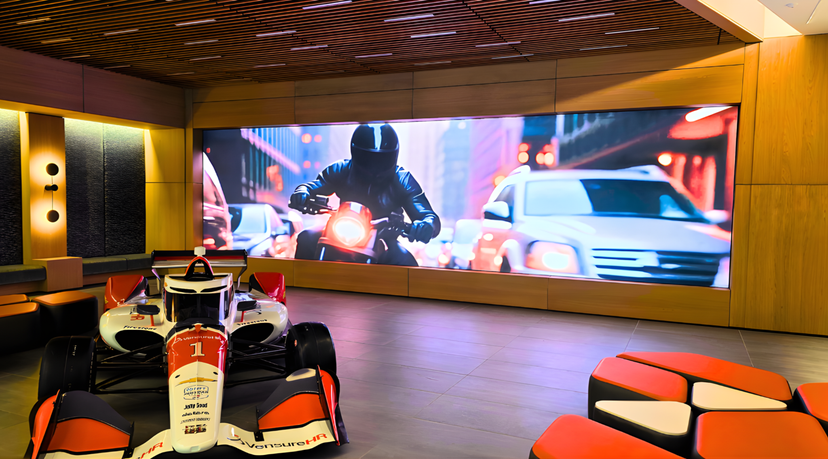
A case study where both scenarios were delivered is at Vensure Employer Solutions’ headquarters in Duluth, Georgia. Trust Fall Technology Group delivered two distinct LED environments within a single integrated scope, demonstrating how viewing distance and use case directly influence LED specification requirements.
The main lobby installation, a 4680×1305 display at 1.9mm pixel pitch, anchors the entry experience with a high-resolution surface calibrated for close-range viewing. The media room, with a 3840×2160 4K studio-grade screen at 1.5mm pixel pitch, was designed to meet the higher-resolution requirements of a professional production and presentation environment.
Both systems were delivered end-to-end, from technical planning and installation through calibration and commissioning, with the Trust Fall team overseeing the entire process.
Arenas, Venues, and Large-Format Installations
Large-format venue and entertainment projects vary significantly based on the display square footage, mounting complexity, and operational requirements. It’s difficult to estimate an exact project cost at this scope. The range is wide, at approximately $500,000 to $5,000,000+.
Large-format venue installations operate at a different scale and under a different set of requirements than close-range corporate or studio environments. Viewing distances are longer, which can allow for wider pixel pitch without sacrificing perceived image quality in some areas of the venue. However, operational demands are more intensive due to extended daily run times, high traffic, and content that requires reliable processing at scale.
Structural requirements are often more complex as well, typically involving custom rigging, freestanding structures, or mounting systems integrated into the venue’s architecture. These factors can significantly increase engineering, fabrication, installation, and long-term operational costs.
One example of how those requirements influence decisions is on the Las Vegas Strip, where Trust Fall Technology Group completed a large-scale, high-resolution LED integration at the Sports Book at Resorts World Las Vegas, one of the newest premier hospitality and entertainment destinations in the market. The project involved fine pitch LED displays across multiple environments on the property. Every specification decision balanced the property’s luxury positioning with the operational demands of a high-traffic entertainment environment running continuously at scale.
Total Cost of Ownership: What to Budget After an LED Wall Install
The upfront cost of an LED wall is what you pay for the hardware and installation, but the ongoing cost profile is also something to consider. When budgeting for the future, total cost of ownership factors such as maintenance, power consumption, operating and service costs, and the display’s expected lifetime should be considered.
LED Wall Maintenance Costs
LED wall maintenance costs vary based on display size, operating hours, environment, and overall system complexity. Common repair incidents, including failed power supplies or control cards, generally range from $1,500 to $5,000 per occurrence. Power supplies and control cards typically fail before the LED chips themselves.
Unplanned failures can involve both replacement parts and emergency labor costs. In high-visibility environments where downtime affects operations or the customer experience, reactive maintenance can quickly become expensive. In many commercial environments, service agreements are a more cost-effective long-term approach.
LED Wall Service Contracts and Lifespan
Service contracts typically range from 3% to 7% of the hardware cost annually, depending on the installation’s size and complexity. These agreements are particularly common for commercial LED displays because of their long operational lifespan.
Commercial LED panels are rated for 80,000 to 100,000 hours of operation. That translates to roughly 18 to 22 years of daily use at 12 hours per day before significant brightness degradation. Power supplies and control cards will typically require service before the panels themselves.
Service contracts that include preventive maintenance, priority response, and discounted replacement parts can help create more predictable long-term operating costs over that lifespan.
LED Wall Power Consumption and Operating Costs
Annual LED wall power costs can range from $2,000 to $15,000+, depending on display size, operating brightness, environment, and daily runtime. High-brightness outdoor LED installations operating at peak nit levels draw significantly more power than indoor fine pitch displays running at standard brightness.
For large commercial LED installations operating extended daily hours, energy consumption can become a significant long-term operating expense. Power usage should be factored into the total project budget during the planning stage rather than treated as a post-installation consideration.
Permanent LED Video Wall Installation vs. Temporary Rental: Which Makes Financial Sense?
For a one-time event or short-term activation, LED video wall rental is often the more practical choice because it avoids upfront capital investment and keeps operational responsibility with the provider. Average LED video wall rental costs typically range from approximately $5,000 to $25,000 per day or event.
The calculation shifts when the use case becomes recurring. A display needed for quarterly events, ongoing brand activations, or permanent lobby or venue use will eventually reach a break-even point where cumulative rental spend exceeds the cost of ownership, often within 18 to 36 months.
In these situations, a permanent LED video wall installation often becomes the more cost-effective long-term investment while delivering better visual integration, image quality, and customization.
Beyond the financial break-even point, permanent installations also provide a level of finish and architectural integration that temporary rental hardware typically cannot replicate in a permanent commercial environment.
Turnkey LED Packages vs. Custom LED Integration: How to Know Which Is Right for Your Project
A turnkey LED package is a pre-configured system with defined specifications, a standard mounting approach, and a set installation scope. It is cost-efficient and appropriate when display requirements are predictable. For buyers needing a functional commercial display in a straightforward environment on a defined budget, a turnkey package delivers real value.
A custom LED integration starts with the environment, not the catalog. The architecture, viewing conditions, content strategy, and operational requirements define the specification. The result is a custom direct-view LED system built for its specific context rather than adapted to it.
When it comes to custom LED video wall installations, the cheapest quote is rarely the lowest-cost outcome. An underspecified system in a high-performance environment can create visible performance limitations that become expensive to correct after commissioning.
Trust Fall Technology Group delivers both approaches with the same level of technical rigor and oversight from concept through commissioning and can help you decide which approach is best for your project.
To learn more about the difference, read “Custom vs. Standard LED Displays: An Expert Comparison for 2026 Projects.”
LED Video Wall Cost FAQ
How much does a 10×10 commercial LED wall cost?
Costs vary based on design, pixel pitch, hardware, and environment. Complete installation costs for a fully operational, very basic commercial wall that uses standard SMD (Surface Mounted Diode) technology from low- to mid-tier manufacturers generally start around $30,000. The industry standard for top-tier virtual production display technology is generally in the $150k–$350k range.
How much power does a commercial LED display use?
Power consumption depends on display size and operating brightness. A typical indoor fine pitch installation draws approximately 300–500 watts per square meter at standard brightness. A high-brightness outdoor display at peak nit levels draws 800–1,200 watts per square meter.
How long does a commercial LED display last?
Commercial LED panels are rated for 80,000 to 100,000 hours of operation. That translates to roughly 18 to 22 years of daily use at 12 hours per day before significant brightness degradation. Power supplies and control cards will typically require service before the panels themselves, making a structured maintenance agreement the more cost-effective long-term approach.
What is a PE stamp and why is it required for an LED installation?
A PE stamp is a certification from a licensed Professional Engineer confirming that a mounting structure is designed to safely support the load it carries. For commercial LED installations in public-facing environments, a PE stamp is required for permitting in most jurisdictions. It accounts for display weight, dynamic loads such as wind or seismic forces for outdoor applications, and the structural capacity of the anchoring surface. It is not an optional line item.
Get an LED Display Quote from Trust Fall Technology Group
Commercial LED display projects are not one-size-fits-all, and neither is the pricing. Whether you are planning a fine pitch integration for a corporate headquarters in New York City, a large-format display for an entertainment venue on the Las Vegas Strip, or a precision-grade LED system for a branded environment in Los Angeles, the right specification depends on the space and the performance standard that needs to be met.
Trust Fall Technology Group designs, engineers, and installs commercial LED display systems across the full spectrum of B2B environments. From turnkey packages for straightforward commercial applications to bespoke, precision-engineered integrations where architecture, technology, and content strategy must work as one system, we deliver complete direct view LED solutions built for the environments they operate in and the audiences they serve.
Contact us for a cost breakdown for your commercial LED video wall project.
contact us